

Tales from the Trenches: Have we traded Resilience for Efficiency?
- November 17, 2026
- Article
Have we become so dependent on the systems that make life easier that we have forgotten how to function when they fail?
Every November, we pause to remember those who paid the ultimate price for the freedoms we enjoy. Remembrance Day is an opportunity to reflect on independence, sacrifice and the value of being able to determine our own future.
Yet there is an interesting contradiction in modern society. While we commemorate freedom and independence, we increasingly trade elements of both for convenience, comfort and perceived security.
We have centralized our information, outsourced our infrastructure and placed enormous trust in a relatively small number of technology providers.
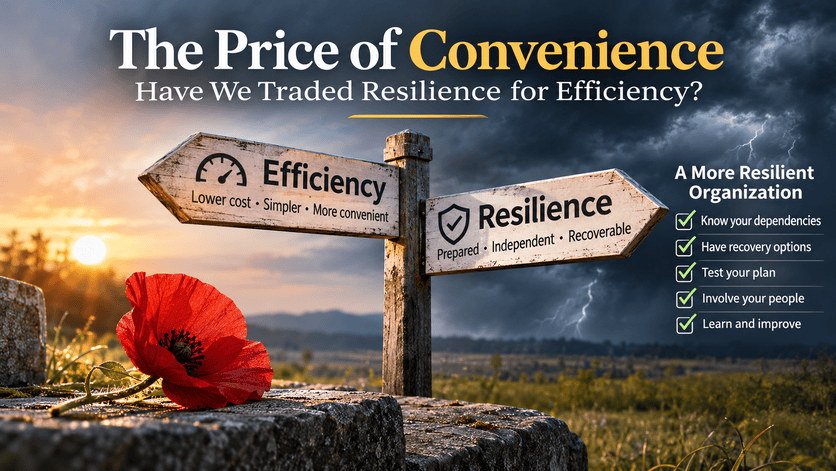
This past week provided a reminder of the risks. Microsoft experienced a significant service disruption, while a telecommunications infrastructure change contributed to widespread disruption in the US aviation system. Neither was necessarily the result of an extraordinary external attack. Both demonstrated how an ordinary operational failure can have consequences far beyond its immediate location and shattered the illusion of reliability.
Cloud computing has transformed business. Amazon, Microsoft and Google provide capabilities that most organizations could never economically build themselves.
But there is a cost: dependency.
We have seen this before. Amazon experienced a significant outage in 2017 following an operational error. Google suffered widespread disruption in 2019 following a network configuration change. AWS experienced further service disruptions in 2021.
Each incident exposed the same fundamental weakness: interconnected systems can create dependencies that are not always apparent until something fails.
We should distinguish between reliability and resilience.
Reliability is about keeping something working. Resilience is about maintaining or restoring the ability to function when something stops working.
They are not the same thing.
Nassim Nicholas Taleb explores this distinction in his book Antifragile. He describes three ways systems respond to stress. A fragile system breaks under pressure. A robust system withstands pressure. An antifragile system actually benefits from uncertainty and disruption by learning and improving.
The objective is not to predict every possible failure. It is to design systems that can withstand the unexpected, recover and become better prepared.
This requires redundancy, alternative operating procedures, decentralization and, most importantly, a willingness to test our assumptions. Consider a flood, fire, earthquake, cyberattack, telecommunications failure or cloud outage. The causes are different, but the consequences are the same.
Employees cannot access information. Customers cannot be served. Financial transactions cannot be processed. Management cannot make informed decisions.
The important question isn't which disaster might happen. It is whether we understand what the organization needs to recover.
Recently, a client asked us to conduct a failure and recovery exercise. It is an excellent request, and one that more organizations should consider.
The process begins by identifying essential business functions, establishing recovery priorities and documenting responsibilities. Staff must be involved because a recovery plan written exclusively by management or IT may overlook the practical realities of running the business.
Then comes the most important part: testing.
Can employees access the information they need? Can customers be contacted? Can orders be processed? Can financial records be recovered? How long does it take to restore essential operations? A successful test isn't one in which nothing goes wrong. It is one in which weaknesses are discovered, documented and corrected.
A backup is not a recovery plan. Having a plan is not proof that it works.
Over the past several decades, businesses have pursued efficiency with remarkable success. We have eliminated redundant infrastructure, centralized operations, outsourced services and automated processes.
These decisions have created enormous economic value. But efficiency and resilience are not necessarily aligned.
A business with one supplier, one network connection and one method of accessing its information may be extremely efficient on an ordinary day. It may also be extremely vulnerable when something unexpected happens.
Redundancy costs money. Alternative systems and recovery procedures require investment. But what is the cost of being unable to operate for a day, a week or longer?
These are business decisions, not IT decisions.
We cannot prevent every failure, nor should we expect technology to eliminate uncertainty. But we can understand our dependencies, test our recovery procedures and preserve alternatives.
Perhaps the most important lesson from this week is that convenience should not come at the expense of resilience.
A resilient organization is not one that never experiences failure. It is one that understands its vulnerabilities, knows how to recover and becomes stronger through the experience.
We cannot control every event that may disrupt our lives or businesses. But we can control how prepared we are to respond.
And preparation should begin before the lights go out.
About us and this blog
Kobelt Development Inc. is an information systems support company which provides top quality and consistent client care.
Contact Us
At KDI we offer excellent customer service to clients all the while making their lives easier and simpler through the use of information technology.
Subscribe to our newsletter!

Site content
More from our blog
See all posts




Recent Posts
- Tales from the Trenches: Have we traded Resilience for Efficiency? November 17, 2026
- Not ALL AI is Created Equal November 3, 2026
- KPI's What You Measure is What You Get September 16, 2026