

You may have noticed that when you Google something, Gemini now pops up to help with the results. Or perhaps you use Bing and Copilot is right beside you, guiding your search. The velocity of AI’s infiltration and adoption into business and everyday life is overwhelming. If you don’t see it, then it is probably well disguised.
For years, businesses have invested heavily in backlinks, keywords and other SEO tactics to get noticed by Google. Those things still matter, but the rules of discovery are changing. If you want to remain relevant and visible to potential customers and clients, you are going to have to start thinking about how AI finds and understands your business, not just how Google ranks your website.
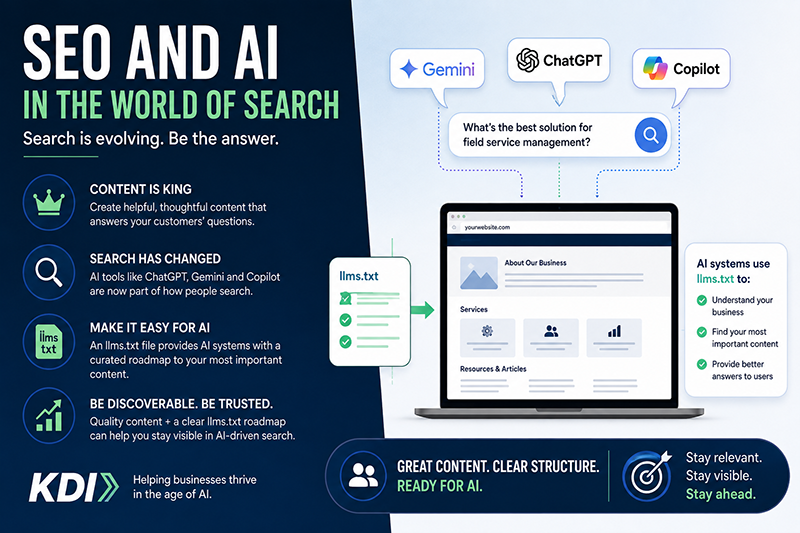
The good news? It isn’t that hard. We have always advocated that content is king when it comes to SEO. That is even more important now. When you write thoughtful, useful articles that answer your customers’ questions, you aren’t just creating content for Google anymore. That same content can help AI systems understand your business, your expertise and the problems you solve can use that information when helping someone find an answer.
AI hasn’t killed search. It has changed it. Search is increasingly becoming the foundational layer underneath AI. People may ask ChatGPT, Gemini or Copilot a question rather than typing a series of keywords into Google, but those systems still need reliable information from somewhere.
That brings us to something relatively new: llms.txt.
If you have heard of robots.txt, the concept will sound familiar. An llms.txt file is intended to provide AI systems with a concise, structured guide to the important content on your website, essentially telling it what information you consider useful and relevant.
It is important to recognize that llms.txt is an emerging standard, not a magic switch that guarantees AI visibility. Not every AI system currently uses it. But creating one is relatively simple, and it is another way of making your website’s structure and important content easier for AI systems to understand.
I’ve been experimenting with this myself. I pointed ChatGPT at our websites and asked it to review the sites and generate an llms.txt file. The process produced some genuinely useful feedback about the websites themselves, as well as a proposed llms.txt file. We reviewed the recommendations, refined the content, and forwarded the resulting files to Ivy on our team to install on the websites.
It didn’t require a massive project. It was simply another step in making sure our websites are communicating clearly with the increasingly important AI layer of the internet. And that is really the point. You don’t need to become an AI expert to start preparing your website for AI-driven search.
Start with the basics: Create useful content. Answer your customers’ questions. Clearly explain what you do. Make sure your website is technically sound. And consider creating an llms.txt file to provide AI systems with a concise roadmap to your most important content.
The search engine isn’t going away. Search is becoming the foundation underneath AI. The businesses that continue to produce useful, authoritative content, and make that content easy for both people and machines to understand, will be in a much better position as the way people discover businesses continues to evolve.
For practical advice and support specific to your organization, don’t hesitate to connect with KDI. If you’d like some help reviewing your website, or preparing it for the changing world of AI-assisted search, feel free to contact us at KDI.ca.
About us and this blog
Kobelt Development Inc. is an information systems support company which provides top quality and consistent client care.
Contact Us
At KDI we offer excellent customer service to clients all the while making their lives easier and simpler through the use of information technology.
Subscribe to our newsletter!

Site content


Recent Posts
- KPI’s What You Measure is What You Get September 16, 2026
- SEO and AI: In the World of Search September 1, 2026
- From Builders to Information Architects July 21, 2026