

It was a typical Monday morning when I received a call from a client.
He had clicked on an email from a trusted sender and immediately suspected something was wrong. Recognizing the potential seriousness of the situation, I handed the issue to Mark, our cybersecurity specialist.
After investigating, Mark’s conclusion was both reassuring and unsettling.
The reassuring part was that the client acted quickly and we were able to contain the threat.
The unsettling part was that this wasn’t a careless mistake. It was a sophisticated attack that could have fooled almost anyone.
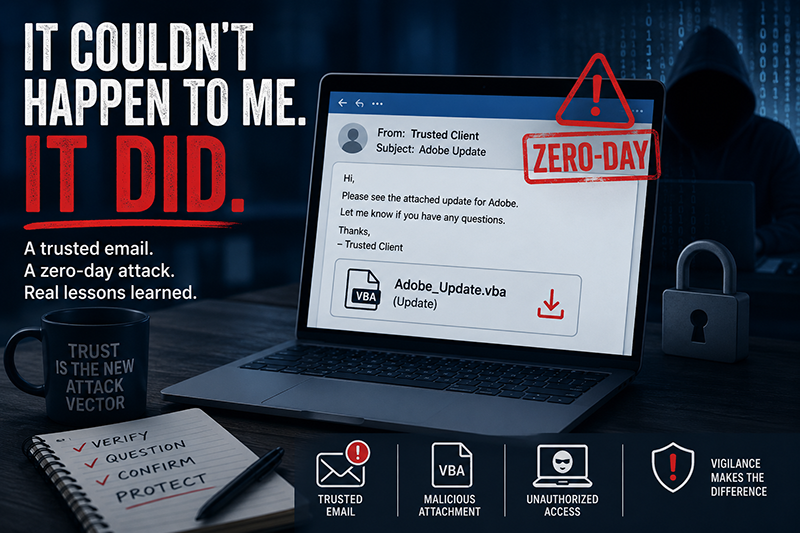
When Trust Becomes the Attack Vector
For years, cybersecurity training focused on spotting suspicious emails from unknown senders. Today’s attackers have adapted.
In this case, the email came from a legitimate contact whose account had already been compromised. The attacker used an existing relationship to spread the infection.
The email appeared within an ongoing conversation. The language was familiar. The request seemed reasonable.
There were none of the obvious warning signs we traditionally associate with phishing attacks.
That’s what made it dangerous.
What Happened
The email instructed the recipient to download an “Adobe update.”
After the file was executed, several suspicious indicators appeared:
- A remote access program was installed without the user’s knowledge.
- A new user account was created.
- Hidden access mechanisms were discovered.
- The script appeared designed to create multiple ways for an attacker to regain access to the computer.
What made the situation particularly challenging was that standard security tools found nothing unusual.
Windows Defender reported no threats.
VirusTotal found no matching malware signatures.
There was no documented history of this specific threat.
In cybersecurity terms, this was effectively a zero-day attack—malicious activity that had not yet been identified by traditional security tools.
The Response
When dealing with an unknown threat, certainty matters more than convenience.
Mark reviewed system logs, examined registry changes, investigated newly created accounts, and analyzed the suspicious files. Although there was no known malware signature, the evidence strongly suggested malicious activity.
The safest course of action was clear:
- Back up essential business data
- Reinstall Windows from scratch
- Reset passwords for critical accounts
- Rebuild the system on a known-clean foundation
It was more work than attempting a cleanup, but it eliminated uncertainty.
In cybersecurity, uncertainty is risk.
Lessons Learned
This incident reinforced several practical lessons for every business owner and employee.
- Be suspicious of unexpected downloads.
Software updates rarely arrive through email attachments. If an email suddenly asks you to install an update, pause before clicking. - Pay attention to file types.
The “Adobe update” was actually a VBA script—a file type that most users should never need to run. When the technology doesn’t match the request, that’s a warning sign. - If nothing happens, something may be wrong.
After the update was launched, Adobe didn’t open and no visible update occurred. Software that claims to do something but appears to do nothing deserves immediate investigation. - Verify unusual requests—even from trusted contacts.
This is perhaps the most important lesson. The email came from someone the client knew and trusted. If a request feels unusual, pick up the phone and confirm it directly. A thirty-second conversation can prevent days of recovery work.
Final Thought
Many people read stories about phishing attacks and think, “I would never fall for that.”
The reality is that modern cybercriminals are no longer attacking technology alone—they are attacking trust.
This client wasn’t careless. The email was believable, timely, and came from a trusted source.
What prevented a much larger problem was vigilance. The client recognized that something felt wrong, reported it immediately, and allowed us to investigate before more damage could occur.
In today’s threat landscape, that may be the most important security tool any organization possesses.
About us and this blog
Kobelt Development Inc. is an information systems support company which provides top quality and consistent client care.
Contact Us
At KDI we offer excellent customer service to clients all the while making their lives easier and simpler through the use of information technology.
Subscribe to our newsletter!

Site content




Recent Posts
- KPI’s What You Measure is What You Get September 16, 2026
- SEO and AI: In the World of Search September 1, 2026
- From Builders to Information Architects July 21, 2026