

Artificial Intelligence has become one of the most frequently used terms in business conversations. Almost every software provider is talking about AI, and business owners are increasingly asking how AI can be incorporated into their operations.
But there is an important distinction that often gets overlooked: not all AI applications are created equal, and not all AI implementations require the same investment, integration, or level of risk.
When discussing AI for a business application such as YourRadar, we need to distinguish between three different capabilities: Generative AI, Analytical AI, and Agentic AI. Each offers significant opportunities, but they solve different problems.
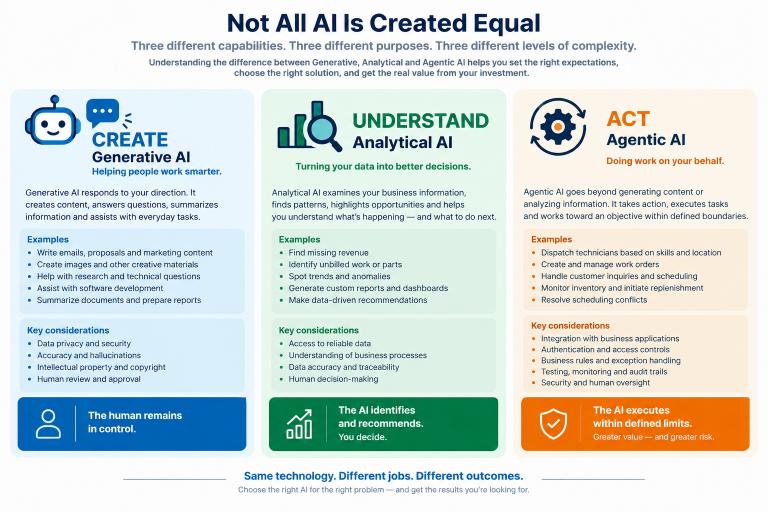
- Generative AI: Helping People Work Smarter
This is the AI most people are familiar with today. Tools such as ChatGPT, Copilot, and Gemini allow users to generate content, answer questions, summarize information, and assist with everyday tasks.
For a business, this might mean:
- Writing customer emails, proposals, and marketing articles.
- Creating images and other marketing materials.
- Helping employees research technical questions.
- Assisting with software development.
- Summarizing documents and preparing reports.
The interaction is relatively straightforward. A person provides instructions, AI generates a response, and the person decides what to do with it.
Integrating generative AI into an existing application can be relatively simple, although privacy, security, accuracy, and appropriate access to business information still need to be considered.
The important point is that you remain in control of the outcome.
- Analytical AI: Understanding Your Business
The next opportunity is using AI to examine business information and help management make better decisions.
Imagine asking your field service software:
"Where am I losing revenue?"
To answer that question, AI needs access to operational data and an understanding of how the business works. It might examine completed work orders that haven't been invoiced, technician hours that haven't been billed, parts used but not recorded, or approved quotes that never became work orders.
It could identify patterns, highlight discrepancies, and present opportunities that might otherwise go unnoticed.
This is where business intelligence, data analytics, and AI begin to work together.
The value isn't simply generating a report. It's helping business owners understand what is happening in their business and where they should focus their attention.
Analytical AI can provide substantial value without necessarily having permission to change anything. It identifies and recommends; management decides.
- Agentic AI: Doing Work on Your Behalf
This is where things become considerably more complicated.
Agentic AI goes beyond generating content or analyzing information. It is designed to take action, execute tasks, and work toward an objective within defined boundaries.
Consider automated technician dispatch.
An AI agent might be expected to review incoming service requests, consider technician availability, skills, geographic location, job priority, customer commitments, and existing schedules, and then assign the appropriate technician.
That sounds straightforward until you consider the implementation.
The AI needs access to scheduling and customer information. It needs reliable APIs to communicate with the application. It must understand business rules, recognize exceptions, handle conflicting appointments, and know when to ask a human for assistance.
It also needs extensive testing.
What happens when a technician calls in sick? What if a customer changes an appointment? What if the job requires a certification that only one technician holds? What if the AI makes an assignment that conflicts with an existing commitment?
These aren't simply AI questions. They are operational, integration, and software engineering challenges.
Giving AI permission to create or change business transactions introduces an entirely different level of responsibility. Security, permissions, audit trails, testing, and human oversight become essential.
The cost and complexity of implementing agentic AI can therefore be considerably greater than adding a generative AI assistant.
Three Different Opportunities, Three Different Implementations
The distinction is important because businesses sometimes approach their software providers with a general request: "We want AI in our business."
But what does that actually mean?
Do you want employees to write emails and generate reports more efficiently? Do you want to identify missing revenue and improve business decisions? Or do you want AI to independently schedule technicians, communicate with customers, and execute operational processes? These are very different projects.
Each has its own implementation requirements, investment, and risk profile.
Start With the Business Problem, Not the Technology
AI offers tremendous opportunities for businesses of all sizes. However, successful implementation begins by identifying the business problem, understanding the required information and processes, and determining how much authority AI should have.
For businesses, there are immediate opportunities to improve productivity, uncover revenue leakage, simplify reporting, and reduce administrative work. Other opportunities, such as fully automated dispatch, may require considerably more engineering and investment.
The objective shouldn't be to incorporate AI simply because everyone else is doing it.
It should be to apply the right AI capability to the right business problem, with realistic expectations about what is involved.
About us and this blog
Kobelt Development Inc. is an information systems support company which provides top quality and consistent client care.
Contact Us
At KDI we offer excellent customer service to clients all the while making their lives easier and simpler through the use of information technology.
Subscribe to our newsletter!

Site content
More from our blog
See all posts

Recent Posts
- Not ALL AI is Created Equal November 3, 2026
- KPI's What You Measure is What You Get September 16, 2026
- SEO and AI: In the World of Search September 1, 2026