

Even when leaders understand the relationship between culture and innovation, introducing AI still requires careful leadership. Technology alone rarely drives change; people do.
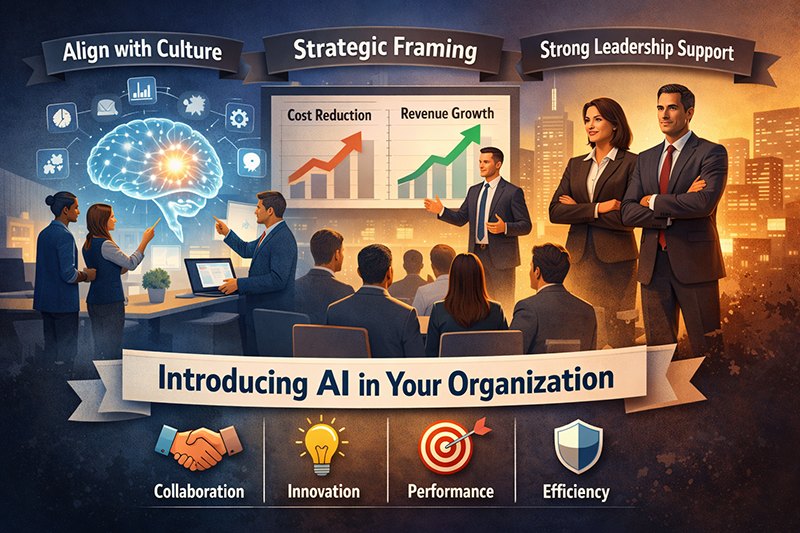
Executives who successfully introduce AI tend to follow three principles: align projects with culture, frame the initiative strategically, and secure visible leadership support.
Start with Cultural Alignment
The first step is selecting AI initiatives that reinforce the organization’s dominant cultural values.
For example:
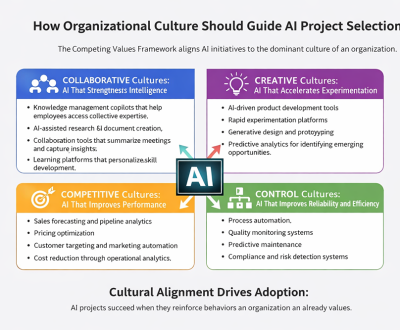
- Collaborative organizations should begin with AI that enhances knowledge sharing and team effectiveness.
- Creative organizations should prioritize AI experimentation platforms and discovery tools.
- Competitive organizations should focus on AI that directly improves performance metrics.
- Control-oriented organizations should begin with operational efficiency and risk management applications.
These early successes build confidence and create momentum for broader adoption.
Frame the Initiative Carefully
Even culturally aligned projects require careful framing.
Research on innovation adoption shows that organizations without a dominant culture, or those with strong stability-oriented cultures, are more likely to adopt innovations when they are framed in terms of cost reduction or revenue growth.
This means leaders should pay close attention to how AI initiatives are presented internally.
For example:
A collaboration tool may gain stronger support when positioned as a way to accelerate decision-making or reduce project delays.
The underlying technology remains the same, but the framing aligns with organizational priorities.
Visible Leadership Support Is Essential
Across all organizational cultures, one factor consistently improves innovation success: strong executive sponsorship. Employees watch closely to see whether new initiatives have genuine leadership support. When executives allocate resources, communicate clear expectations, and actively champion the project, employees interpret the initiative as strategically important. Without this signal, adoption often stalls.
Build Momentum Through Early Wins
AI adoption rarely happens all at once.
Successful organizations typically begin with projects that fit their culture and produce visible results. These early successes reduce skepticism and encourage broader experimentation. Over time, the organization becomes more comfortable integrating AI into its core processes.
Culture Shapes the Path to AI
The rush to adopt artificial intelligence has led many companies to focus primarily on technology capabilities. But the most important factor may be far less technical: organizational culture. Companies that align AI initiatives with their cultural strengths dramatically increase their chances of success. Those that ignore culture often struggle—even with promising technologies.
The lesson for leaders is clear. Before asking what AI can do for your organization, ask a simpler question:
What kind of organization are we?
The answer may determine which AI initiatives succeed and which quietly disappear.
Feel free to contact us to determine your organization’s culture and the best initial AI initiative.
About us and this blog
Kobelt Development Inc. is an information systems support company which provides top quality and consistent client care.
Contact Us
At KDI we offer excellent customer service to clients all the while making their lives easier and simpler through the use of information technology.
Subscribe to our newsletter!

Site content





Recent Posts
- Introduce AI in Any Organizational Culture April 1, 2026
- How Organizational Culture Should Guide Project Selection March 25, 2026
- Keeping Legacy Systems Running — While You Plan What’s Next March 24, 2026