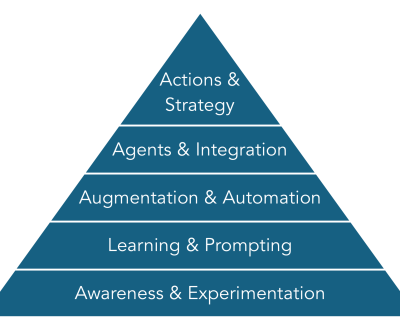
Once leaders recognize that culture influences innovation adoption, the next challenge is practical: how do we choose AI initiatives that actually fit our organization?
The Competing Values Framework offers a useful starting point. By identifying the dominant cultural orientation of a company, leaders can dramatically improve the odds that AI initiatives will gain traction. Each culture type favors different kinds of projects:
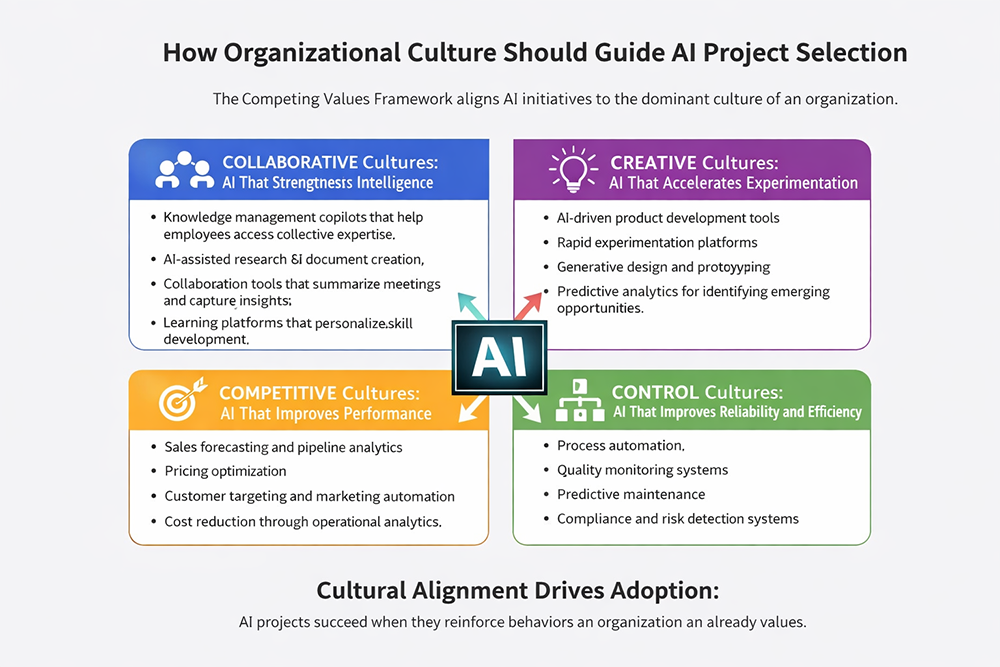
Collaborative Cultures: AI That Strengthens Collective Intelligence
Organizations with collaborative cultures emphasize trust, mentoring, and shared learning. Employees succeed by working together rather than competing against one another.
AI initiatives that perform best in these environments include:
- Knowledge management copilots that help employees access collective expertise
- AI-assisted research and document creation
- Collaboration tools that summarize meetings and capture insights
- Learning platforms that personalize skill development
These projects succeed because they amplify the core cultural value of shared knowledge. When AI strengthens collective intelligence, adoption spreads organically through teams.
Creative Cultures: AI That Accelerates Experimentation
Creative cultures thrive on exploration, risk taking, and new ideas. These organizations are typically comfortable experimenting with emerging technologies.
AI initiatives that perform well in these environments include:
- AI-driven product development tools
- rapid experimentation platforms
- generative design and prototyping
- predictive analytics for identifying emerging opportunities
In these organizations, AI becomes a discovery engine. Leaders often succeed by encouraging experimentation rather than tightly controlling outcomes.
Competitive Cultures: AI That Improves Performance
Competitive cultures prioritize measurable results for example: market share, revenue growth, and operational performance. AI initiatives that succeed here tend to deliver visible performance improvements, such as:
- sales forecasting and pipeline analytics
- pricing optimization
- customer targeting and marketing automation
- cost reduction through operational analytics
Projects framed around collaboration or learning often struggle in these environments because they do not immediately translate into measurable outcomes, but AI initiatives that directly improve performance metrics can spread rapidly.
Control Cultures: AI That Improves Reliability and Efficiency
Control-oriented organizations emphasize stability, standardization, and predictable outcomes. These companies often approach innovation cautiously, but they can adopt AI successfully when it reinforces operational discipline.
Examples include:
- process automation
- quality monitoring systems
- predictive maintenance
- compliance and risk detection systems
In these environments, AI is most effective when positioned as a tool for improving reliability rather than experimentation.
Cultural Alignment Drives Adoption
The key lesson is that projects succeed when they reinforce the behaviors an organization already values. Leaders who ignore cultural dynamics often choose projects that sound exciting but fail to gain internal support.
Those who align AI initiatives with their organization’s cultural strengths dramatically increase the likelihood of successful adoption.
In the final article in this series, we will explore how executives can design AI strategies that work within each culture type and how culture can evolve over time as organizations become more comfortable with AI.
About us and this blog
Kobelt Development Inc. is an information systems support company which provides top quality and consistent client care.
Contact Us
At KDI we offer excellent customer service to clients all the while making their lives easier and simpler through the use of information technology.
Subscribe to our newsletter!

Site content