Artificial intelligence has moved faster into organizations than almost any prior general-purpose technology. In a matter of months, tools that once felt experimental have become default companions for writing, research, analysis, and design. AI is no longer something companies are “considering.” It is already embedded in daily work — often informally, unevenly, and without clear intent.
This rapid adoption has created a paradox. Many organizations report productivity gains, yet just as many express discomfort with the quality, trustworthiness, and distinctiveness of AI-generated output. What we are witnessing is not a failure of AI capability, but a failure of structure.
The result is a growing volume of what some have begun to call AI slop: content that is fluent but shallow, confident but derivative, and plentiful without being particularly useful.
The problem is not that AI generates low-quality work. It is that AI faithfully reflects the conditions under which it is used. When adoption is driven by individual curiosity rather than organizational clarity, AI amplifies inconsistency rather than insight.
This pattern is familiar. Email accelerated communication but also produced overload. Spreadsheets democratized analysis while simultaneously enabling false precision. Dashboards increased visibility while encouraging attention to metrics that were easy to measure rather than meaningful to act upon. Each wave improved capability while introducing new forms of noise.
AI follows the same trajectory — but at greater speed.
In many organizations, AI use today is opportunistic. Employees experiment on their own, applying tools wherever friction exists: drafting emails, summarizing documents, generating proposals, rewriting marketing copy. Individually, these uses are rational. Collectively, they can degrade clarity.
Common symptoms include:
- Increasing content volume without corresponding improvement in decision quality
- Outputs that sound polished but lack context or originality
- Convergence toward similar language and ideas across firms
- Overconfidence in answers that have not been validated
These effects are not signs that AI is “overhyped.” They are signs that AI is being used without a clear understanding of where human judgment still matters most.
The deeper issue is that AI lowers the cost of production far faster than it improves the quality of thinking. When generating text, images, or analysis becomes trivial, the scarce resource is no longer effort — it is discernment.
This creates a new managerial challenge. In the past, leaders focused on whether work could be produced efficiently. Increasingly, the question is whether work should be produced at all, and whether it contributes meaningfully to understanding, action, or differentiation.
Organizations that struggle most with AI adoption tend to make one of two mistakes. Some treat AI as a novelty, relegating it to experimentation without accountability. Others attempt to deploy it everywhere at once, assuming scale itself will produce value. Both approaches miss the same point: AI does not substitute for judgment; it magnifies the consequences of its absence.
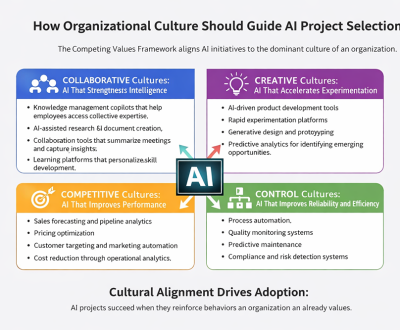
More disciplined organizations start with narrower questions. They ask where better thinking, not just faster output, actually changes outcomes. They distinguish between work that benefits from generative assistance and work that requires context, experience, or responsibility. They accept that not all tasks should be automated, and that restraint can be a competitive advantage.
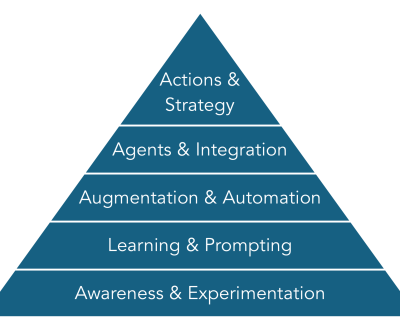
Importantly, these organizations also recognize that AI adoption is not binary. It unfolds in stages, from individual experimentation to operational augmentation and, eventually, decision support. Confusion arises when leadership speaks in the language of advanced AI while the organization is still operating at an early stage of maturity. Expectations rise faster than capability, and disappointment follows.
The rise of “AI slop” is therefore not an argument against AI. It is an argument for intentional adoption. Without structure, AI increases noise. With structure, it can improve focus, consistency, and insight.
The organizations that will benefit most from AI are not those that generate the most content, but those that are most selective about where AI is applied and where human judgment remains central. They treat AI not as a replacement for thinking, but as a force multiplier for disciplined reasoning.
In an environment where everyone has access to the same tools, advantage will not come from adoption alone. It will come from clarity — about purpose, about limits, and about what still requires a human decision.
For more information, or to continue the discussion, feel free to contact KDI.
About us and this blog
Kobelt Development Inc. is an information systems support company which provides top quality and consistent client care.
Contact Us
At KDI we offer excellent customer service to clients all the while making their lives easier and simpler through the use of information technology.
Subscribe to our newsletter!

Site content