

Stop Treating AI as a Single Project: Build an AI Project Portfolio Instead
- April 16, 2026
- Article
Many organizations approach artificial intelligence the same way they approach any new technology: they launch a pilot project. Perhaps it’s an AI chatbot. Or a sales forecasting model. Or a generative AI assistant to help employees write reports. Sometimes the project succeeds. Often it struggles. And frequently it disappears quietly after the pilot phase. The problem is not necessarily the technology. It is the strategy.
AI adoption should not be managed as a single initiative. It should be managed as a portfolio of innovation projects aligned with the organization’s culture.
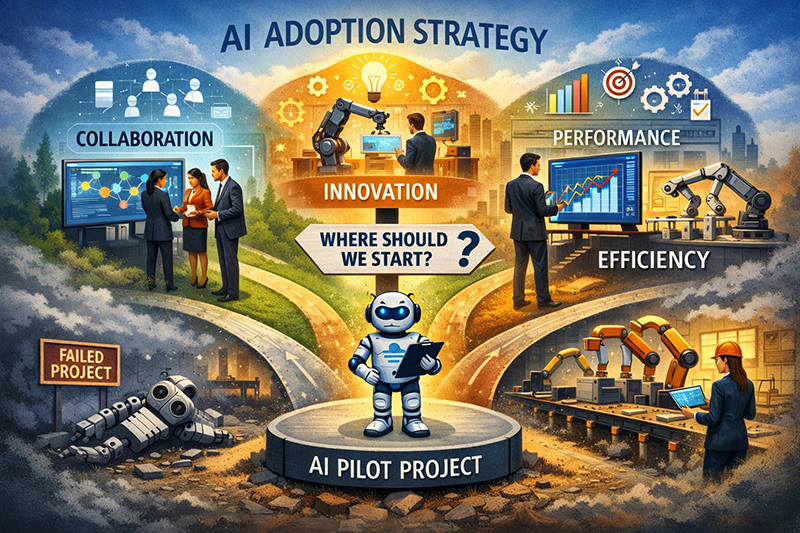
AI Adoption Is an Innovation Strategy Problem
Artificial intelligence is not a single capability. It is a broad class of technologies that can improve decision-making, automate processes, generate content, and discover patterns in data.
Because AI can influence many parts of an organization, leaders often struggle with a fundamental question: Where should we start? The instinct is usually to look for the “best” use case. But research on innovation adoption suggests that this approach overlooks a critical factor: organizational culture strongly influences which innovations succeed.
Some cultures adopt experimentation easily. Others adopt operational improvements more readily. Some respond best to revenue-oriented innovations, while others prefer tools that strengthen collaboration.
For this reason, successful organizations rarely rely on a single AI initiative. Instead, they develop a portfolio of projects aligned with how their organization works.
Culture Shapes the AI Portfolio
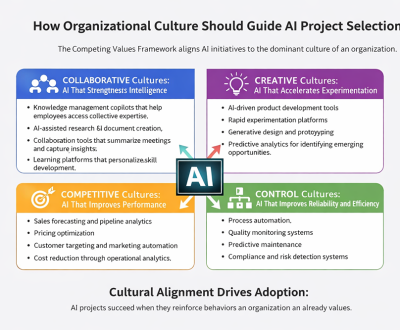
The Competing Values Framework identifies four dominant cultural orientations. Each supports different kinds of innovation, and an effective AI portfolio reflects this cultural reality.
Organizations with collaborative cultures often benefit from AI initiatives that enhance collective intelligence. Their portfolios may emphasize knowledge assistants, learning platforms, and tools that capture and share expertise across teams.
Organizations with creative cultures are often more comfortable experimenting with emerging technologies. Their portfolios typically include discovery-oriented AI projects such as generative design, advanced analytics, and experimentation platforms.
Organizations with competitive cultures respond most strongly to innovations that improve measurable results. Their AI portfolios often focus on sales analytics, pricing optimization, customer targeting, and operational performance tools.
Organizations with control-oriented cultures tend to adopt technologies that improve reliability and efficiency. Their portfolios frequently emphasize process automation, predictive maintenance, compliance monitoring, and operational analytics.
None of these portfolios is inherently better than another. They simply reflect different cultural strengths.
Why the Portfolio Approach Works
Managing AI adoption as a portfolio provides several advantages.
First, it reduces cultural resistance. When most projects reinforce existing cultural values, employees are more likely to engage with the technology rather than resist it.
Second, a portfolio spreads innovation risk. Not every AI project will succeed, particularly in a rapidly evolving technological landscape. Multiple initiatives allow organizations to learn while minimizing disruption.
Third, the portfolio approach creates a natural learning curve. Early projects that align closely with organizational culture build confidence and develop internal expertise. Over time, organizations can experiment with more ambitious applications.
In this way, the portfolio evolves alongside the organization’s capabilities.
Start with Cultural Strengths
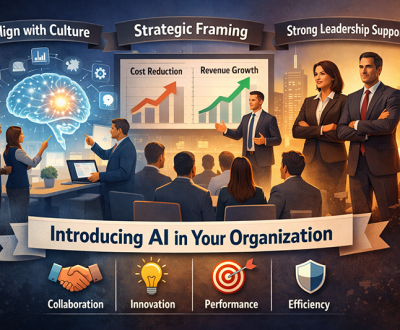
The most common mistake leaders make when introducing AI is attempting to transform the organization and introduce new technology simultaneously. While cultural change is possible, it typically occurs gradually. AI initiatives are far more likely to succeed when they begin by reinforcing the organization’s existing strengths.
For example, a company with a strong competitive culture may achieve early success with AI-driven revenue analytics. A control-oriented organization may build confidence through process automation. These successes create credibility for future initiatives.
Over Time, the Portfolio Can Expand
As organizations gain experience with AI, their innovation portfolios often broaden. Teams become more comfortable experimenting with new tools. Leaders develop a clearer understanding of where AI creates value. And employees begin to see how the technology can improve their work. At this stage, organizations can begin exploring projects that extend beyond their traditional cultural comfort zone. But those initiatives are far more likely to succeed once a foundation of early success exists.
The Strategic Question for Leaders
The most important question for executives considering AI adoption is not simply “What can AI do?”, but “What combination of AI initiatives makes sense for our organization?”
Answering that question requires understanding the cultural dynamics that influence innovation adoption.
Organizations that build AI portfolios aligned with their cultural strengths will move faster, encounter less resistance, and achieve more sustainable results. Those that ignore culture may continue launching promising projects, only to watch them stall before they deliver meaningful impact.
About us and this blog
Kobelt Development Inc. is an information systems support company which provides top quality and consistent client care.
Contact Us
At KDI we offer excellent customer service to clients all the while making their lives easier and simpler through the use of information technology.
Subscribe to our newsletter!

Site content

Recent Posts
- KPI’s What You Measure is What You Get September 16, 2026
- SEO and AI: In the World of Search September 1, 2026
- From Builders to Information Architects July 21, 2026