

Executives often assume that innovation fails because of poor planning, weak project management, or insufficient resources. As a result, organizations invest heavily in methodologies, tools, and frameworks designed to improve execution. Yet many well-managed innovation projects still fail. The missing variable is organizational culture.
Research into innovation adoption across U.S. organizations suggests that the success of an innovation initiative depends less on project management rigor than on whether the initiative fits the organization’s dominant cultural orientation. In other words, innovations do not fail simply because they are poorly managed. They fail because they are planted in the wrong cultural soil. Culture determines whether innovation even gets considered.
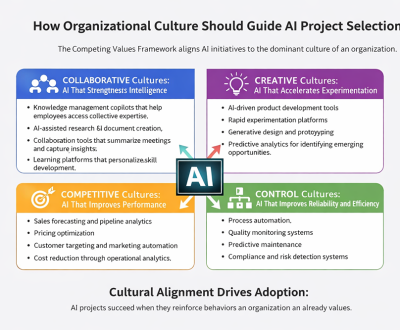
Using the Competing Values Framework, organizations can broadly be grouped into four dominant cultural orientations: collaborative (clan), creative (adhocracy), competitive (market), and control (hierarchy).
The research found a clear pattern: organizations that emphasize flexibility and collaboration are more likely to introduce innovations in the first place. By contrast, organizations that emphasize stability, control, and competition are significantly less likely to adopt new ideas.
This finding reinforces what many experienced managers intuitively observe. In organizations where predictability and performance metrics dominate, new initiatives are often perceived as unnecessary risk. Innovation proposals must overcome not only technical uncertainty but also cultural resistance.
Project Management Helps – but It Cannot Overcome Culture
One of the more surprising findings was the limited role of project management practices.
The study confirmed that applying more project management best practices increases the probability of implementation success. However, the effect is incremental rather than decisive. Even well-structured projects struggle when they conflict with the organization’s cultural norms.
In statistical terms, organizational culture proved to be a stronger predictor of innovation success than project management practices alone.
This helps explain why companies frequently replicate successful innovation processes from other firms but fail to achieve similar results. The methodology travels easily; the culture does not.

The Type of Innovation Must Match the Culture
When culture is resistant to change, the framing of the innovation becomes critical.
In organizations without a clearly dominant culture—or where stability-oriented cultures dominate—innovations framed around cost reduction or revenue growth were significantly more likely to succeed than those framed around abstract improvements such as collaboration or organizational learning.
In practical terms, the same technology can succeed or fail depending on how it is positioned.
For example, a collaborative platform introduced to “improve teamwork” may struggle in a competitive culture where individual performance is rewarded. The same platform framed to accelerate sales cycles or reduce operational costs may gain traction. The technology has not changed. The cultural alignment has.
Leadership Support Is the Decisive Factor
Across all cultural types, one factor consistently improved the likelihood of success, that is active senior management support.
Projects with realistic expectations, adequate resources, and clear executive sponsorship performed significantly better than those launched as grassroots initiatives. While this may seem obvious, the research suggests the reason is deeper than governance. Executive support signals that the innovation aligns with the organization’s priorities and norms.
Without that signal, employees often interpret the initiative as temporary or politically risky.
What This Means for AI Initiatives
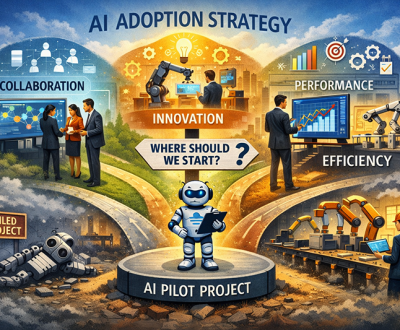
Today many organizations are rushing to implement artificial intelligence tools across their operations. But the same cultural dynamics apply.
An AI project intended to “enhance collaboration” may fail in a highly competitive culture where employees are rewarded for individual performance. Similarly, AI tools designed to support experimentation may struggle in organizations built around strict control and predictability.
Leaders should therefore begin not with the technology, but with the cultural context.
Before launching a major innovation initiative, you should ask three questions:
- What is our dominant organizational culture?
- Does this innovation reinforce or challenge that culture?
- How should the initiative be framed to align with existing incentives and values?
Ignoring these questions is one of the most common—and preventable—causes of innovation failure.
Innovation Requires Cultural Fit
Innovation is often discussed as if it were primarily a technological challenge. It is a cultural one.
Project management practices, change frameworks, and sophisticated technologies all play important roles. But their effectiveness ultimately depends on whether the organization’s culture is receptive to the change being introduced.
Executives who understand this dynamic can dramatically increase the success rate of innovation initiatives, not by managing projects differently, but by aligning innovation strategies with the cultural realities of their organizations.
In the end, the lesson is simple: the most carefully designed innovation will struggle if it is planted in unreceptive cultural soil.
About us and this blog
Kobelt Development Inc. is an information systems support company which provides top quality and consistent client care.
Contact Us
At KDI we offer excellent customer service to clients all the while making their lives easier and simpler through the use of information technology.
Subscribe to our newsletter!

Site content




Recent Posts
- From Builders to Information Architects July 21, 2026
- Cyber Security: “It Couldn’t Happen to Me.” It Did. June 24, 2026
- Tales From the Trenches June 17, 2026