

Executives across industries are asking a reasonable question: Is AI going to stick around?
The skepticism is understandable. Capital is flooding the sector. New tools appear weekly. Valuations seem stretched. The pace feels unsustainable. To many leaders, the current moment resembles past bubbles: railroads in the 1800s, automobiles in the early 1900s, and the dot-com boom of the late 1990s.
History suggests a clear answer: the hype will fade. The transformation will not.
The Predictable Arc of Transformative Technology
Foundational technologies tend to follow a familiar pattern:
- Breakthrough innovation
- Capital surge
- Proliferation and overbuild
- Market correction
- Consolidation
- Infrastructure dominance
In the 19th century, hundreds of railroad companies competed across North America. Many collapsed. A few consolidated into durable networks such as Union Pacific Railroad. Rail did not disappear after the shakeout; it became freight infrastructure.
In the early automobile era, more than 1,800 U.S. car manufacturers launched. Most failed. The industry ultimately concentrated around companies like Ford Motor Company and General Motors.
The dot-com crash followed the same pattern. Speculative firms vanished, while survivors such as Amazon and Google evolved into core infrastructure for commerce and information.
AI is tracking this arc with striking similarity.
The Mistake Leaders Are Making
The confusion today stems from conflating tools with capability.
Yes, there are too many AI applications. Yes, many “wrapper” startups are undifferentiated. And yes, a correction is likely.
But the strategic question is not whether today’s AI logos will survive. It is whether organizations will abandon capabilities that materially improve productivity, compress development cycles, enhance decision-making, and automate cognitive tasks. – History suggests they will not.
When rail reduced shipping time, firms did not revert to horse transport. When automobiles improved mobility, society did not return to carriages. When the internet accelerated communication, companies did not return to fax.
Once operating models adapt to a productivity shift, reversal becomes economically irrational.
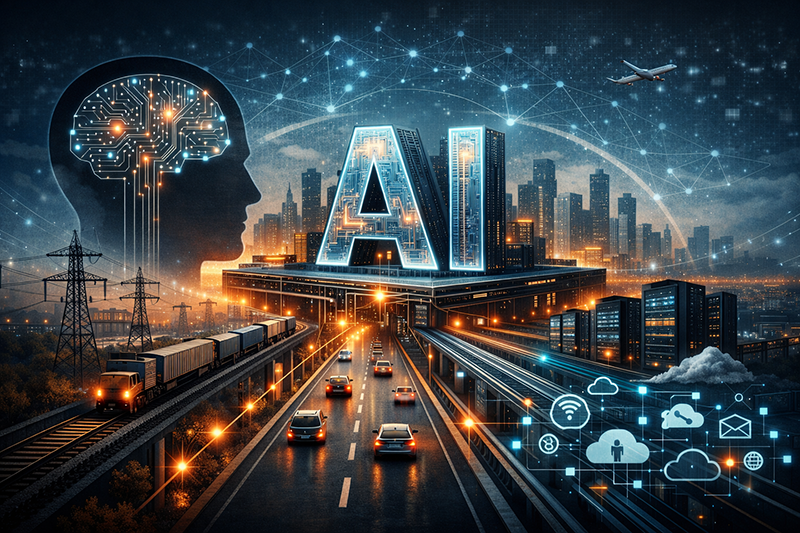
From Product to Infrastructure
The defining feature of durable technology is infrastructure integration.
Infrastructure technologies:
- Reshape workflows
- Redefine cost structures
- Alter competitive baselines
- Change expectations of speed and scale
AI is already doing this.
Organizations are redesigning job descriptions around AI-augmented work. Software development timelines are compressing. Marketing, analytics, support, and coding are increasingly AI-assisted. The productivity ceiling for individual contributors is rising.
This is not a feature enhancement. It is an operating model shift.
Over time, today’s proliferation will narrow. Foundational model providers will consolidate. Enterprise platforms will embed AI natively. Vertical applications will survive where they deliver measurable economic value.
The volatility is real. The direction is structural.
The Inevitable Shakeout
Many AI startups will fail. Valuations will correct. Capital will retreat from speculative edges toward defensible positions.
But shakeouts signal consolidation, not retreat.
Railway bankruptcies did not end rail transport. The dot-com crash did not end the internet. In each case, excess capital accelerated experimentation, and the correction clarified which players would become infrastructure.
AI is unlikely to remain as noisy as it is today. It will become more embedded, less visible, and more expected.
And that is precisely how infrastructure behaves.
The Strategic Question
The better question is not, “Will AI survive?”
It is:
How will AI reshape my industry’s cost structure and competitive baseline and, more importantly, how quickly must I adapt?
Leaders who treat AI as a temporary tool risk underestimating its permanence. Leaders who treat it as emerging infrastructure can focus on redesigning workflows, rethinking talent leverage, and redefining competitive advantage.
The hype may cool. The capability will not.
About us and this blog
Kobelt Development Inc. is an information systems support company which provides top quality and consistent client care.
Contact Us
At KDI we offer excellent customer service to clients all the while making their lives easier and simpler through the use of information technology.
Subscribe to our newsletter!

Site content

Recent Posts
- SEO and AI: In the World of Search September 1, 2026
- From Builders to Information Architects July 21, 2026
- Cyber Security: “It Couldn’t Happen to Me.” It Did. June 24, 2026