

The Stages of AI Adoption: Why Most Implementations Fail Early
- February 17, 2026
- Article
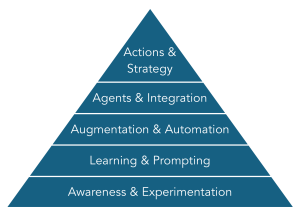
As artificial intelligence spreads across organizations, a familiar pattern is emerging. Leaders speak confidently about “AI strategy,” while teams struggle to move beyond scattered experimentation. Pilots stall, expectations outpace results, and early enthusiasm gives way to quiet skepticism.
These failures are often attributed to technology limitations, talent shortages, or cultural resistance. In reality, many stem from a more basic problem: a misunderstanding of where the organization actually is in its AI adoption journey.
AI adoption is not a single decision or deployment. It is a progression of capabilities that unfold over time. Treating it as binary: either “we use AI” or “we don’t” creates unrealistic expectations and poorly sequenced investments.
A more useful lens is to think in terms of staged maturity, where each level builds on the one below it.
Stage 1: Awareness and Experimentation
At this stage, AI enters the organization informally. Individuals experiment with public tools such as ChatGPT or web-based copilots, often outside official workflows.
The value here is learning. Employees begin to understand what AI is good at, where it fails, and how it changes the pace of work. The risks are inconsistency and false confidence, particularly when outputs are trusted without validation.
This stage is unavoidable and necessary. Problems arise only when organizations mistake experimentation for implementation.
Stage 2: Learning and Prompted Use
In the second stage, AI usage becomes more intentional. Individuals or teams develop repeatable prompts and apply AI to specific categories of work: drafting content, summarizing documents, preparing presentations, or responding to routine communications.
Productivity gains are real, but uneven. The quality of output depends heavily on prompt design and human review. Without shared standards, organizations risk scaling poor practices rather than improving outcomes.
At this stage, AI improves efficiency, but it does not yet change how work is organized.
Stage 3: Augmentation and Task-Level Automation
The third stage marks an important transition. AI begins to assist with discrete operational tasks rather than ad hoc requests. Examples include ticket triage, CRM updates, meeting summarization, document classification, or code assistance.
This is often where measurable return on investment first appears. Manual effort declines, cycle times improve, and work becomes more consistent.
However, this stage also introduces new managerial challenges. Responsibility for AI-assisted outputs must be clearly assigned. Human oversight remains essential, particularly when AI outputs influence customers, finances, or compliance.
Many organizations underestimate the governance required at this level, assuming task automation is inherently low risk. It is not.
Stage 4: Workflow and Orchestrated Agents
In the fourth stage, AI moves beyond individual tasks and begins to coordinate across systems. Agents are triggered by events rather than people, managing multi-step workflows that span applications.
Examples include onboarding workflows, customer service escalation paths, billing and collections processes, or security monitoring. AI no longer waits for input; it initiates action.
The benefits are speed and scale. The risks are opacity and silent failure. When AI-driven workflows break, errors may propagate before they are detected.
At this stage, observability, logging, and clear escalation paths become as important as the AI models themselves.
Stage 5: Decision and Action Support
The final stage involves AI supporting or, in constrained cases executing, decisions. Forecasting, pricing recommendations, staffing optimization, and predictive maintenance fall into this category.
Here, AI does not simply reduce effort; it shapes outcomes. The stakes are correspondingly higher.
Organizations that reach this stage successfully maintain a clear separation between recommendation and authority. AI informs judgment; it does not replace it. Where that boundary blurs, trust erodes quickly.
Why Staging Matters
Most organizations operate across multiple stages simultaneously. Marketing teams may be at Stage 2, operations at Stage 3, and leadership discussing Stage 5 aspirations. Failure occurs when governance, controls, and expectations remain stuck at the earliest stage.
The most common AI implementation mistake is attempting to leapfrog stages: deploying advanced tools without the operational discipline required to support them. Maturity cannot be skipped; it must be built.
Successful organizations align ambition with capability. They invest in learning before automation, in augmentation before orchestration, and in governance before delegation.
AI adoption, done well, is not about speed. It is about sequencing.
About us and this blog
Kobelt Development Inc. is an information systems support company which provides top quality and consistent client care.
Contact Us
At KDI we offer excellent customer service to clients all the while making their lives easier and simpler through the use of information technology.
Subscribe to our newsletter!

Site content

Recent Posts
- KPI’s What You Measure is What You Get September 16, 2026
- SEO and AI: In the World of Search September 1, 2026
- From Builders to Information Architects July 21, 2026